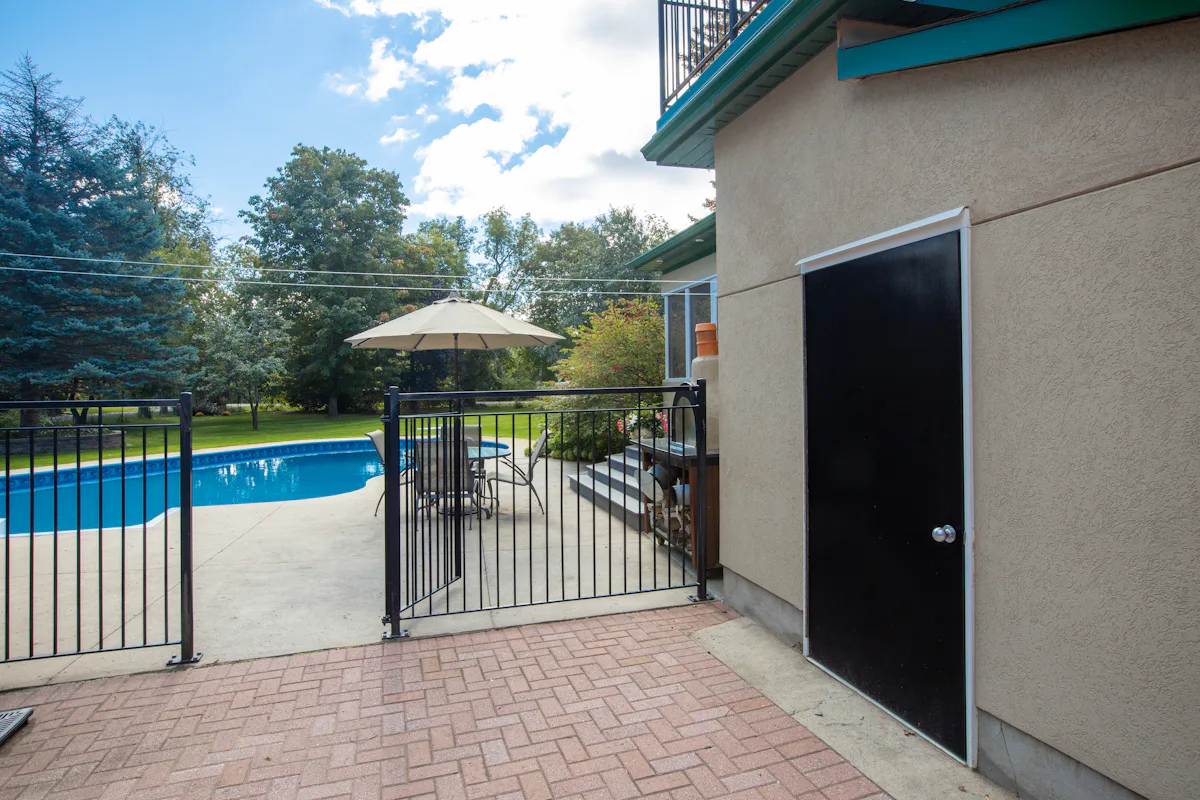
What does Chandler require around a pool?
The City of Chandler's pool fencing guidance (page last updated June 2026) and its homeowner permit manual say:
- All pools must be enclosed by a perimeter fence of masonry, concrete or decorative fencing, at least 6 feet and not over 7 feet high, measured on the outside.
- A building permit is required before pool fencing is built.
- An existing wood fence must be replaced with masonry, concrete or decorative fencing when a pool goes in.
- Openings must not let a 4-inch sphere pass, and the outside must have no hand or foot holds.
- Pedestrian gates must self-close and self-latch, with the latch more than 54 inches above grade. Gates for openings wider than 4 feet must have a locking device and stay locked.
- An interior barrier between the house and the pool may be 4 feet high. Doors into the pool area must self-close or have an audible alarm.
How is that different from Arizona state law?
Arizona's statute (A.R.S. 36-1681) sets a 5-foot minimum barrier with similar gap, gate and latch rules. It also lets cities that adopt equal or stricter ordinances apply their own rules. Chandler's 6-foot perimeter requirement is one example, so the state minimum is not enough here.
Does the RV gate count?
If the RV gate is part of the pool enclosure, it is part of the barrier. Chandler's guidance says gates on openings wider than 4 feet need a locking device and must be kept locked. We build wide gates with that in mind. See RV gates.
Which materials work?
Block walls make up most Chandler pool perimeters. For interior barriers, steel or aluminum picket fencing is common because it leaves the pool visible from the house. Picket spacing, rail placement and the gap at the bottom all have to be right, and we check them before inspection.
Replacing a pool fence?
Chandler's manual says the pool area must stay secured during construction when a pool fence is replaced. We plan the order of work so there is never an open side overnight.